Friday, November 18, 2016

Advertising Week 11

15.11.2016 (Week 11)
David Ho Ming Aun (0328394)
Advertising Principles and Practice
Project 3 Progress

Project 3:
As this is the week before the final project submission, it is only rightful that a lot of progress has to be made. 

I began finalising down the patterns that would work to serve my purpose. I've also done it all in colour in order to see how the contrast would work. There are the following:


Figure 1: Finalised Pattern 1 "Stroke Width"

Figure 2: Finalised Pattern 2 "Dots"

Figure 3: Finalised Pattern 3 "Zig-zag"

Figure 4: Finalised Pattern 4 "Circles"

Figure 5: Finalised Pattern 5 "Noodles"

I then explored further into how to place the typography within the boundaries of the ad space. 


Figure 6: Typographic Arrangements Experimentation

Figure 7: Typographic Arrangements Experimentation

Figure 8: Typographic Arrangements Experimentation

Figure 9: Typographic Arrangements Experimentation

I've decided to go with the white box style in Figure 7 as it allows for an unobstructed view of the key art while maintaining a sense of unity between graphic and text box.

That being said, I attempted to place these into the confines of the advertising medium dimensions. 

Upon consultation of the lecturer, they are the following:
1. Newspaper Quarter-page Advertisement: 130 x 180mm
2. Billboard Advertisement: 48 x 14ft
3. Web Banner Advertisement (Wide Skyscraper): 160 x 600px
4. Magazine Full Page Advertisement (Men's Health): 210 x 175mm
5. Ambient Advertisement: A1 594 x 841mm

These were the media that was suggested by my lecturer. However, upon closer reevaluation, I realise that it is very important to put in something onto social media networks, as I have outlines in my Project 2 slides. Therefore, I must decide to remove one of the media stated above and replace it with the social media advertisement.

I have chosen to remove the magazine advertisement because of the small readership base. Therefore, I removed the magazine ad and included the Social Media Advertisement, which dimensions are as follows:

Social Media Advertisement (Facebook): 700 x 700px

I will now attempt to explain in detail my processes for each medium's advertisement:

Newspaper Quarter-Page Advertisement
For this ad, I wanted to use the dots because it was similar to dot matrices in halftone printing. I decided for a quarter page ad despite wanting to blow it up to a full-page ad because I did not want to be too loud about an advertisement about condoms in a Malaysian newspaper. I took the dimensions from The Star newspaper and simulated my advertisement in its size.


Figure 10: Newspaper Ad Draft

Billboard Advertisement
I was very concerned about the legibility and also whether or not people can see the advertisement from that distance. After some thought as looking at my printouts from afar, I decided on the following pattern to be used.


Figure 11: Billboard Ad Draft

Web Banner Advertisement
This was an interesting suggestion by my lecturer. He suggested to actually make the web banner into a .gif (an idea I thought of doing before, but never thought to execute it because I had never done one before). But through the saving grace of Google, I can now make glorious .gifs.


Figure 12: Web Banner Ad "Look it moves!"

Ambient Advertisement
I thought of either putting these ambient ads in toilets or entrances to nightclubs or bars. Later on I decided to keep it out of the toilet as toilets have the impression of being a dirty place.. generally not a very nice place to be thinking of something so intimate.

The ambient advertisement took a few experiments before getting it right. 

Figure 13: Toilet Ambient Test
Figure 14: Toilet Ambient Test

Figure 15: Brick Ambient Test

Figure 16: Brick Ambient Test
My final advertisements will be posted up in Week 12's post, along with their simulations.


Feedback:

Specific Feedback
The lecturer gave lots of feedback about how appropriate it would be to use particular patterns in particular situations and gave his opinion on which one would be better to use or not. His responses were quite encouraging regarding my ads. 


Reflection:

Experience
This week was really tiring for me as I had to work on other projects as well. With little sleep it was hard to maintain focus, but I pushed on because this is the final lap. Not too healthy a lifestyle, but an art student's got to do what an art student's got to do.

Observation
I observe myself extremely productive this week despite the tiredness. I also find that using earphones helps me maintain stronger focus. Is it because it acts like a tether to the machine? Or does it block out the outside world better? Whatever it is, it's working.

Findings
I find that the advertisements are beginning to look good and I have reached that point in my creative process where I can slowly see the final forms emerging. It is an exciting part, but I should also be careful and not get ahead of myself because this step is very important to prevent any mistakes. I can't wait to finish this up.

Image sources:
Figure 1 – 16 Personal Documentation

Sunday, November 13, 2016

Advertising Week 10

08.11.2016 (Week 10)
David Ho Ming Aun (0328394)
Advertising Principles and Practice
Project 3 Progress

Project 3:
I have come up with more drafts for the invisible pattern designs, as well as explored the use of some appropriate typefaces for the advertisement. Do note that the following images are slightly edited after the consultation session with my lecturer. The feedback he gave is included in the feedback section. Changes I have made include: reducing point size of the stroke, reducing the inter-line spacing and changed the shape of the condom to reflect a more universal icon of a condom.

Figure 1


Figure 2

Figure 3

Figure 4

Figure 5

Figure 6


I also explored the typefaces to be utilised in the advertisement. Top is PT Sans Condensed, and the bottom is Source Sans Pro. I'm gravitating towards Source Sans Pro.

I did a lot of printouts this week to see how it would look like actual size. I realise it is very different seeing it in print and on the computer screen, and I need to start printing more tests in order to have an accurate view on the designs.


Feedback:
Specific Feedback
My lecturer said that some of the lines are too thick and the spacings are too wide. He encouraged me to look at how to incorporate the tagline and USP in a more elegant manner rather than simply placing it at the bottom , which apparently ruins the flow. He also suggested using a grid pattern. He also said my portfolio is well-organised.


Reflection:
Experience
I'm glad I put in more work during the break to actually come up with more patterns and possibilities. 

Observation
I still observe myself putting this to the side. I believe this is because the current step in the process is very tedious and visually boring. However, I understand that it crucial to get it right from the foundation up so that I won't slow myself down in the coming steps. 

Findings
I find that the deadlines truly motivate me to do good work. It is not something I want to rely on, but being accountable to deliver something by a certain time gives me the motivation to churn out proper honest work. 

Advertising Week 9

25.10.2016 (Week 9)
David Ho Ming Aun (0328394)
Advertising Principles and Practice
Project 3 Progress


Instructions:
Final Project: Advertising Campaign (part 2): Art Direction
Final Project & Portfolio 40%


The Brief
Advertising Campaign (Part 2): Art Direction

Duration of Assignment
5 Weeks (Briefing on Week 8)

DEADLINE
Week 13 (21 Nov 2016)

Description
The student now has the task of developing an Advertising Campaign – a total of 5 ads across different/same media – for the Playsafe Condom Brand, and its Air Ultra Thin product. Utilising the insights researched (Project 2), the ideas developed (Project 1), and the determined media strategy (Project 3), execute a well art directed, crafted, creative advertising campaign that maintains the mood, tone and most importantly conveys the ad message (USP/SMP) consistently throughout the different/same media. Create an advertising campaign that is on message, on target and makes a lasting impact visually and emotionally.

In part 2 of the advertising campaign, the focus is on the students ability to translate the creative idea into concepts that are well art directed and crafted ad. campaign, taking into consideration the target audience, media and the socio-cultural factors.

The brand: Playsafe Condoms

The product: Air Ultra Thin (See figure 1.)
SMP/USP: Extremely thin condom for extra sensitivity

Target Audience: Gen Y.

Requirements
The student must document their progress in their eportfolio and the A4 hardcopy portfolio. The final results must be printed out for the A4 hardcopy portfolio, and the Adobe PDF and JPEGs of the final artworks must be uploaded to your eportfolio. Ensure all aspects of your journey in this process is documented – failures, successes, epiphanies, sketches, visual research, etc.

Submission

All gathered information (failures, successes, epiphanies, sketches, visual research, etc.) documented chronologically in the A4 Clear Sheet folder. The works must be labelled and dated.
All gathered information (failures, successes, epiphanies, sketches, visual research, screen grabs, websites, images, etc.) documented chronologically in the eportfolio for every week, for the duration of the project.
A3 print outs of the individual ads from the campaign and simulated print outs of what it would look like in its actual setting.

Objectives
To develop students ability to ideate effectively.
To develop students ability to synthesise knowledge.
To develop students ability to gain and utilise insight for effective advertising
To develop students ability to create and execute an effective ad. message.
To develop students ability to determine a media mix based on analysis.


Project 3:

Based on my idea sketches in the past weeks, I tried to digitise them roughly to see how they would actually look like with right angled straight lines.

Figure 1
Here I tried to imagine it with some colours. The greens are taken from the packaging of the Playsafe condom.
Figure 2
 I also tried out using different patterns and effects, such as Bloat or Twirl, etc. 

Figure 3
Figure 4


Figure 5

Figure 6
I also tried using overlapping concentric circles to subtly highlight the border between the condom and the background.

Figure 7

Figure 8

Figure 9
For this one I tried a different effect in Photoshop. I just watched Doctor Strange, you see.

Figure 10
Here is a rough ambient mock up that I could utilise in my campaign.

Figure 11
I want to find that balance between being too blatantly obvious and too hard to see, so I will try and narrow down some suitable ones.


Feedback:
Specific Feedback
The lecturer said that it's looking promising and I should keep at it. He mentioned how the ad in Figure 10 could be used for a secondary wave of advertisements. He said the ambient in Figure 11 is suitable and doable. 


Reflection:
Experience
It felt rather awkward in class at first as there was no lecture as we have finished our lecturing sessions. I felt pretty bad because I hadn't come up with sufficient progress on the condom advertisements. However, I do appreciate whatever feedback my lecturer is able to provide me.

Observation
I observe myself putting this at a lower priority than my other projects, as this project has the impression of being able to be completed very quickly. However, I recognize that putting no work into the projects would only delay the project. Working with all these patterns is extremely tiring on the eyes.

Findings
I find that I need to pick up my pace and focus on this project more. I should take breaks from staring at the screen for so long.


Picture Credits
  • Figure 1 – 11 — Personal Documentation

Sunday, October 23, 2016

Advertising Week 8

18.10.2016 (Week 8)
David Ho Ming Aun (0328394)
Advertising Principles and Practice
Advertising Message and Choice of Media

Lecture: Advertising message and choice of media
This week's lecture is quite interesting as it covered how the media can affect the message of the advertisement greatly. The terms media and new media were firstly defined, followed by media strategy and Integrated Media Communications (IMC). Lots of wonderful examples were shown where the medium of the advertisement proved to be vital in ensuring the effective delivery of the intended message. 

Marshall McLuhan provides a bold quote: "The medium is the message." The five factors that are utilized in deciding a media strategy as outlined by Arens and Schaefer (2007) are outlined: Market, Money, Media, Mechanics and Methodology. This is conveniently known as the 5Ms, and we will be using this in Project 2. 

Outcomes from the lecture:
  • As important as the advertisement itself is, the medium on which it is placed upon plays an important role and has the potential to elevate the message.
  • The difference between IMC and marketing strategy.
  • The 5Ms in planning a media strategy. 


In-class challenge:
Only this very brief brief was provided by our lecturer:

Here you go. You have one hour to mind-map, ideate, and digitize.
Figure 1: Brief for the Logo Design Competition 
We sat down together and began to try to make mind maps of things that represent Malaysia and New Zealand. We were not able to find any solid ideas or digitise it, but we managed to explore some possibilities to the executions. 
Figure 2: Mind Maps (1/2)
Figure 3: Mind Maps (2/2)

We will be continuing to work on the logo through the weeks as it is incorporated into two of our modules, Advertising and Branding.


Project 2:
Secondary Research

I proceeded to study more in-depth about the different media and their suitability in relation to both my advertising campaign and the target audience, Generation Y. The following information is what I have mined and compiled. Do note that these are merely a collection of information — the synthesized and summarized information can be seen on the slides.


Print Media:
I found a wealth of information from this article: https://contentequalsmoney.com/print_media_for_gen_y/

The article lists down many resources, and some facts:
  • 60% of Millennials said they’d cut their shopping spending if they didn’t look at newspaper inserts
  • 91% said they use print coupons, ads, and sale notices to save money
  • 51% said print ads inspire them to make a purchase
  • 30% said they go online to find more information about a product after seeing it in a print ad
  • a whopping 87% use print ads to select which restaurants to eat at
  • 84% find coupons and discounts on clothing in print ads, and 71% shop ads to find the best price for apparel
To put some of these numbers in perspective, Valassis found that 86% of people in this age bracket visited Facebook on a daily basis.

In this article: http://www.npr.org/sections/gofigure/2012/05/02/151547286/millennials-and-print-newspapers-a-surprising-story it mentions a State of News Media study by Pew, which found that nearly a quarter of 18 – 24 year olds surveyed had read a newspaper in the past 24 hours. Millennials keep pace with total US adults until it comes to comparing the number of heavy readers. Less than a quarter of Millennials (22%) are reading newspapers at least every other day, compared to 40% of adults overall. However, 52% of them are getting their hands (and eyes) on a newspaper at least once a month and up to fourteen times a month.

In this site (http://smallbusiness.chron.com/print-media-advertising-advantages-3393.html) benefits of using print media to advertise are highlighted as such:
  • Multiple Exposure: Newspapers can be re-read and exposure is not limited to a mere one-time event.
  • Non-Intrusive: Not as intrusive as other media such as radio and TV and therefore the viewer won’t see is as much as an annoyance.
  • Target Marketing: Can target specific target groups. This is especially the case with magazines.
  • Loyal Readership: Longitudinal subscriptions and loyalty allow development of a
  • long-term advertising campaign.
  • Position Flexibility: Advertisers can usually choose where their ads would be
  • placed within a publication.


Social Media:
A pessimistic start to my reseach, this study (http://adage.com/article/digital/study-1-facebook-fans-engage-brands/232351/) claims that "..lightly more than 1% of fans of the biggest brands on Facebook are actually engaging with the brands, according to a study from the Ehrenberg-Bass Institute, an Australia-based marketing think tank that counts Procter & Gamble, Coca-Cola and other major advertisers as its supporters."

Nevertheless, from this social networking fact sheet (http://www.pewinternet.org/fact-sheets/social-networking-fact-sheet/) it is reported that 92% of those in the 18-29 age group frequent sites like Facebook and Twitter, compared to the 73% of runners-up in the 30-49 group.

I found a really comprhensive dissertation by Tingley of Walden University, which can be viewed here: http://scholarworks.waldenu.edu/cgi/viewcontent.cgi?article=2215&context=dissertations.

This dissertation covers many areas, but here are some points that are relevant to using social media as a viable medium of advertising.


  • In support of Fischer and Reuber (2010), 90% of participants in this study found Twitter an effective channel for marketing to Generation Y. Almost half (45%) of the participants mentioned Instagram, while 20% mentioned YouTube for their social media efforts. Patterson (2011) found that Facebook was a strong social media application for consumers; however, although 55% of this study’s participants showed support for Facebook, 30% were specifically against Facebook use when marketing to Generation Y. As one participant commented, “although still maybe Facebook is good for some and not for others, I think that Facebook is actually being utilized now more by the older demographics than the younger demographics” (P13).
  • Huang et al. (2013) applied attitude toward the ad to viral videos and noted that Internet users are most likely to respond to or actively shareInternet content if they view the ad as entertainment.
  • Slightly more than half (55%) of the participants responded to the importance of timing of social media usage and understanding what is new in the industry.
  • In support of findings by Hadija et al. (2012), who stated that members of Generation Y will often only notice an advertisement for a split second, one participant found that “you have to think in little bits, we call it ‘snackables’ or bite-sized bits of information"


Ambient Advertising
Perception of advertising strategies - a qualitative study comparing Generation X and Generation Y: http://www.diva-portal.org/smash/get/diva2:721757/FULLTEXT01.pdf
The conclusion that can be inferred from this research is that Generation Y perceives ambient advertising better than Generation X, since they are more open for this type of advertising.


Billboard Advertising
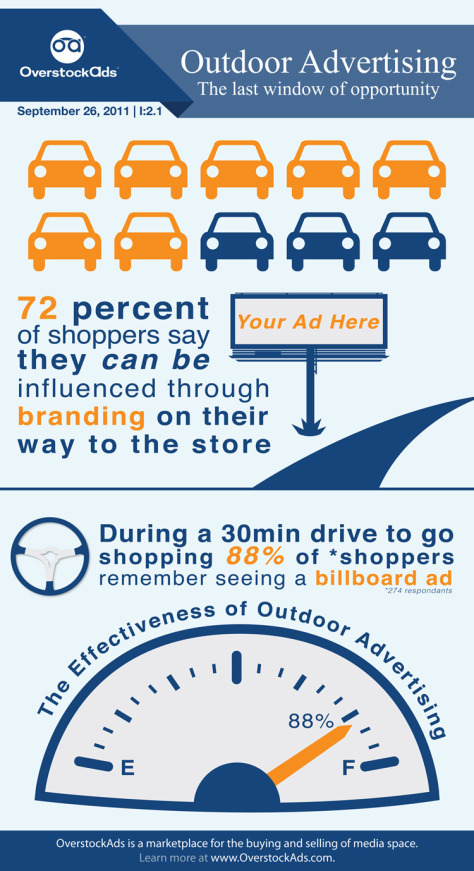
The following infographic proposes some optimistic data and facts supporting the use of billboard advertisements.

Figure 4: Infographic on Outdoor Advertising
(OverstockAds, 2011)


"It was also found that Malaysians are spending more time in traffic gridlock than a year ago (2015), according to an online survey conducted by global carmaker, Ford. Of the 1,050 Malaysian respondents, 55 per cent of them said they spent more time in traffic."

The effectiveness of billboard advertising and the fact that Malaysians are spending more and more time in gridlock on the roads allow the billboards to play a larger role in advertising.


Web banners
Research findings have been looking down for web banners, with articles such as this one (http://www.tintup.com/blog/better-than-banner-ads-smart-ways-spend-ad-dollars-2015-muriel-macdonald/) by TINTUP stating that: "Modern day banner ads have a click rate of less than .1% (or 1 in 1000 people) which means you are more likely to complete NAVY SEAL training than click a banner ad."

However, in this article (http://adage.com/article/digitalnext/defense-banner-ads-hates-work/295782/) by Advertising Age written by Tom Goosman, chief creative officer at digital agency True North, the position of web banners is defended. I quote: "Many have declared that banners are ignored and ineffective. Behavior tells a different story. We see the banner's influence again and again. When we have stopped using banner display ads for clients, we've seen traffic, search and conversions plummet."

I think we can also see how the measure of the effectiveness of a web banner is not as valid as it can be. Measuring a positive value based on click rates does not account for the actual viewing of the advertisement, which could produce that edge that Goosman refers to in the article.

Having compiled all this data, I will now compile and summarise it neatly into the following Google Slides presentation.


Project 2 Slides:


Forum:

Question
In your own words, briefly explain the difference and similarities between Integrated Marketing Communications and Media Mix?

Answer

The Media Mix refers to the types of media chosen to be utilised in an advertising campaign to achieve its objective. There are two distinct streams of media, the traditional media (print, radio, TV) and the new media (online social networks, websites). The interaction between these two mediums are not uncommon today and can prove to be effective in capturing the attention of the target audience.
The Integrated Marketing Communications, on the other hand, is a larger component that encompasses the Media Mix. The Media Mix is but a small part in the IMC, which includes aspects like timing, frequency, budget, and so on. The IMC is vital in the planning and coordination of the overall direction in which the advertising campaign will head, in accordance with the marketing strategy employed.

Feedback:
Specific Feedback
Good presentation. Citation and sources were abundant and supports your assesrtions and claims. Well crafted presentation and well presented (written form). Good work!

General feedback


Reflection:
Experience
I enjoyed the brainstorming sessions together, as we can really speed up the ideation process. I felt more confident with my chosen idea for the Playsafe advertising campaign after having shown it to the lecturer and classmates. 

Observation
I notice that some classmates do not seem too motivated in voicing out their ideas or opinions, which can hinder creative thought and the overall process. I notice the lecturer being very tired these few days. I think he needs to take care of himself as well. I realise I am also quite forgetful, so I have begun writing things down more diligently in my notebook.

Findings
I have found that I tend to put my work off to the last minute, with my productivity levels reaching it's peak just before the deadline. I should probably try to do work more consistently to spread the load throughout the week. 


Book of the Week:

Figure 5: Week 8 Book of the Week
Hey, Whipple, Squeeze This! by Luke Sullivan

I enjoy the witty casual tone that Sullivan has set throughout the book. It doesn't feel so formal and authoritative like Ogilvy's book, but it feels more like a casual albeit passionate chat with your macha at the mamak store. Here are some cool things from the book.


  • Sullivan speaks of a quote by Alex Bogusky, who said: "We try to find that long-neglected truth from the product and give it a hug." Notice how he said 'find' and not 'invent'. It's very important to find the truest thing you can say about the product, to find the central human truth of a product.
  • On idea generation: "Write hot. Edit cold." Get it on paper, fast and furious. Edit later.
  • The book highlights an 'advertising legend' that Bill Bernbach carried a little note in his jacket pocket. Whenever he was having a disagreement with a client, he would take it out to remind himself. In small words, the sentence read: "They may be right."
  • Very interestingly, Sullivan goes through the ways of presenting and defending your ideas, but then criticises the idea of testing an idea to your client. He argues that the idea of testing has the misconception of assuming people react intellectually to commercials, whereas in reality, reactions are something visceral and instantaneous. He provides a wonderful quote by Bill Bernbach: The quote is followed by the following paragraph: "We are so busy measuring public opinion, we forget we can mold them. We are so busy listening to statistics that we forget we can create them." The following in an excerpt from the section that immediately follows the quote: "This simple truth about advertising is lost the minute a focus group sits down to do its business. In those small rooms, the power of advertising to affect behavior is not only subverted, it is reversed. The dynamic of a commercial coming out of the television to consumers is replaces with consumers telling the commercial what to say."

Picture Credits


References:


Entertainment Design - Week 9,10